

Private equity is one of those careers where nobody hands you a manual. Whether you’re coming from investment banking, consulting or corporate finance, you’re expected to hit the ground running on day one, and there is very little formal onboarding. That gap is why PE certificates have multiplied, and why so many of them aren’t worth your time.
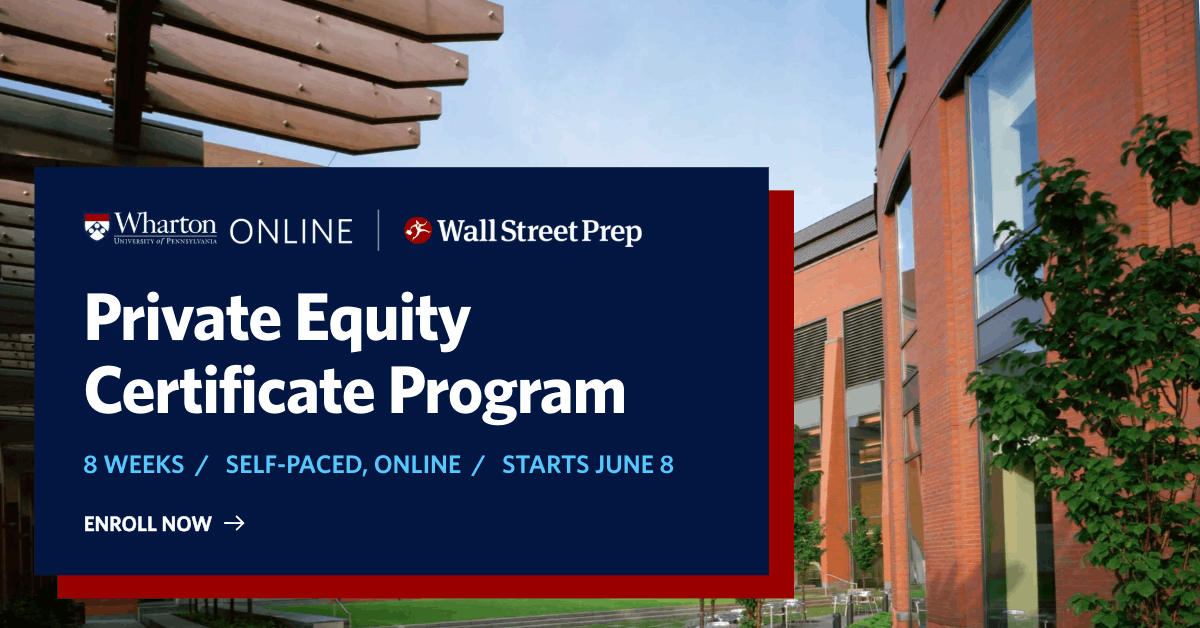
The Wharton Online Private Equity Certificate, run with Wall Street Prep, is one of the more interesting ones. It puts Wharton’s name and faculty oversight on top of practitioner-led training. But is it worth the money and the 8 weeks? How does it compare with the alternatives? Those are the questions to ask before you commit to any course.
Wharton Online Private Equity Certificate Review (2026) – Worth it?
| Duration | 8 weeks, self-paced online |
| Time Commitment | ~8–10 hours per week |
| Work Experience Required | None (but be comfortable with accounting and Excel) |
| Price | Check Now (discounts and payment plans available) |
| Networking | Slack group, office hours, optional meetups in NYC, London and LA |
| Who is it for? | Bankers, fund managers, consultants, senior exectutives |
Desk-ready skills
There is always a gap between what universities teach and what firms need from a new hire. This program is built to close it, and the curriculum is more hands-on than I expected from a university-branded course.
You work through the deal from start to finish: fund structures and GP/LP dynamics, the actual documents (NDAs, CIMs, LOIs, IC memos), financing and private credit, Quality of Earnings adjustments, and asset vs. stock deal structures. Then comes the part that matters most, which is building a full LBO model from scratch with debt schedules, sensitivities and a written recommendation. The final module even prepares you for the PE case interview.
If you’ve sat through enough finance training, you’ll know that last bit is rare. Most courses teach you to build the model. Very few teach you how to defend it.
What you actually learn: the curriculum
I always check a course’s syllabus before its marketing page, because the module list tells you quickly whether it’s real training or a brand exercise. This one is clearly built around the deal itself, and it falls into three parts.
Weeks 1-3: the groundwork. Module 1 covers the asset class: fund structures, the GP/LP relationship, common strategies, returns and hurdle rates, and why leverage is such a powerful (and dangerous) tool. Module 2 walks through the deal process from end to end, including the paperwork you’ll actually touch: NDAs, CIMs, IC memos, LOIs, SPAs/APAs, TSAs, funds flow and credit agreements. Module 3 goes into financing, working capital, Quality of Earnings, purchase price allocation, and how asset vs. stock deals (including 338(h)(10) elections) change taxes and sponsor returns.
Click here and use code BANKERSBYDAY for $300 off tuition on this course!
If you’ve worked on the sell-side or in a bank, much of Module 2 will feel familiar. Module 3 is where most people learn something new, because the tax and structuring detail is what junior bankers usually skim past.
Weeks 4-5: building the model. Modules 4 and 5 are a two-part middle-market case. You first learn private vs. public company analysis, valuation methods (DCF, trading and transaction comps, LBO, football field), and how to build sensible projections. Then you build a full bottom-up LBO with debt schedules and covenants, and finish by turning the output into an investment recommendation.
The last step is the one I’d stress. Anyone can learn the mechanics of an LBO. The harder skill is arguing for or against a deal using the numbers.
Weeks 6-8: thinking like an investor. Modules 6 and 7 cover industry and TAM analysis, moats, revenue builds, cost structures, and the back-and-forth with management over data room requests. Module 7 also covers SaaS and recurring revenue businesses, plus how AI is being used in PE. The AI piece is timely, and as you’ll see below, the speaker lineup backs it up. Module 8 then has you build an LBO from scratch under a PE case-interview setup, covering sources and uses, management rollover, the three statements, debt schedules, exit value and sensitivities.
That last module matters if recruiting is your goal. Case interviews and modeling tests are where many strong candidates fall short, because they are timed and you have to explain your assumptions out loud.
The program also has electives, so you can tailor part of it to your background.
The Wharton name on your CV
Let me start by reiterating that no certification guarantees you a job. This one doesn’t either, and the program itself says it offers no placement.
That said, every finance opening gets hundreds of applicants these days. As someone who has interviewed dozens if not hundreds of finance candidates, I’m always looking for ways to make the initial screening easier. A recognizable name and relevant coursework on a CV does that. The final interviews are where I go in-depth, but the first cut is about quick signals, and a Wharton Online credential is one.
Mix of professors and practitioners
A certification is only as good as the people teaching it. The program pairs Dr. Burcu Esmer, academic co-director of Wharton’s Harris Family Alternative Investments Program, with practitioners from Wall Street Prep: Scott Roman, who has worked on the buy side, sell side and advisory side, and Dylan Lam, a former senior associate at Staple Street Capital who started as an analyst at Moelis.
I like this combination. Academics alone tend to teach theory, and practitioners alone tend to skip the why. You need both.
The guest speakers are a good draw too. They include David Rubenstein of Carlyle, Steven Rattner, Marc Ganzi of DigitalBridge and Martin Brand of Blackstone, plus panelists from firms like Thoma Bravo and Ares.
Click here and use code BANKERSBYDAY for $300 off tuition on this course!
Keynotes: David Rubenstein (co-founder of Carlyle), Steven Rattner (Willett Advisors, former Quadrangle founder and ex-Treasury counselor) and Marc Ganzi (CEO of DigitalBridge, who built Global Tower Partners and sold it to American Tower for $4.8 billion). These are big names, but they’re more about perspective than technique. Treat these sessions as insight into how senior investors think.
Networking
This is where most online certifications fall flat, because you get videos and a quiz and that’s it. Here you also get a private Slack group, graduate-only LinkedIn group, live office hours, fireside chats, and optional in-person meetups in LA, London and New York, ending with a closing ceremony in NYC. Graduates keep access to the community afterwards.
In finance, who you know still matters, so this part deserves more weight than most people give it.
Flexible, but not easy
It’s self-paced, with live weekly office hours. The time commitment is real, though: roughly 8–10 hours a week for two months, which is a lot if you’re also working in banking. And if your accounting and Excel fundamentals are shaky, budget extra time. Wall Street Prep gives you prep videos as soon as you enroll, so you can get a head start.
Wharton PE Certificate vs. the Alternatives
At its current price point, this sits in the middle of the market. It’s not the cheapest but it offers the most value, in my opinion. The course and delivery is great and the guest speakers and keynotes make it world class.
Who Should Take It
- An investment banking analyst or associate who wants PE deal exposure
- A corporate finance professional or MBA looking to move into PE
- A consultant or operator pivoting into investing
- A senior professional who wants both the brand and the practical skills
- Senior executives who need PE know how to run their businesses
- Consultants and advisors as you will likely need to know about the PE business in some capacity
- Very helpful for those managing family offices and other funds
- Business owners, founders etc. who are big enough to execute PE deals
Click here and use code BANKERSBYDAY for $300 off tuition on this course!
Final Thoughts
The Wharton Online Private Equity Certificate is a solid option if you want credibility and job-ready skills in one package. Hands-on LBO modeling, case work, practitioners from top firms and a real alumni network are hard to find at this price. It won’t get you the job on its own, but it should make you a sharper candidate and a faster hire once you’re in.
About the Author