

Even before AI became popular, I knew that its best use would be finance and business in general. We generate and process a ridiculous amount of data – whether its transactions or customer preferences or running infinite scenarios with multiple variables – we always need more compute!
I’ve spent my career in the space between finance and technology. I’ve seen the industry from both sides of the table, and I can tell you that AI is the biggest shift I’ve seen in how business gets done.
So when a certificate comes along that promises to teach AI to finance and business professionals, I pay attention. The AI for Business & Finance Certificate, run by Columbia Business School Executive Education with Wall Street Prep, is one I’m genuinely excited about. This review covers what’s in it, who it’s for, and whether it’s worth your time and money.
Columbia Business School AI for Business & Finance Certificate Review (2026) – Worth it?
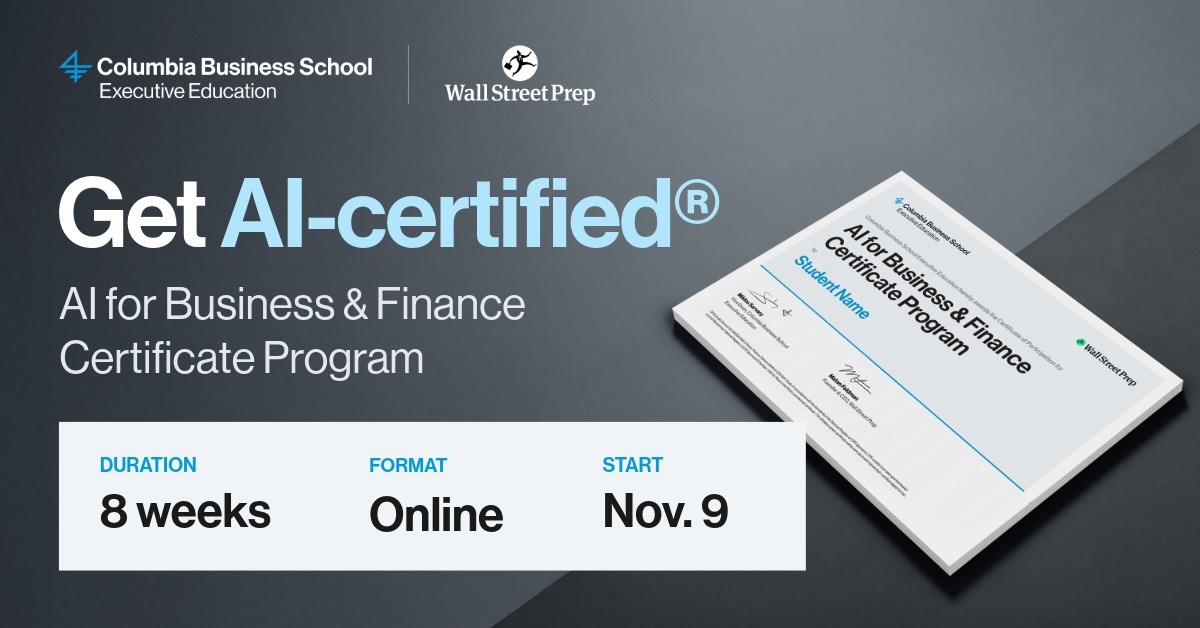
| Duration | 8 weeks, self-paced online |
| Time Commitment | ~8–10 hours per week |
| Coding Experience Required | None |
| Cohorts | Three per year |
| Price | Check Now |
| Credits | 65 CPE credits |
Why AI skills matter now
Let me start with the obvious question: why should a banker, manager or consultant care?
Because the work itself is changing. Analysts spend huge amounts of time pulling data, cleaning it, summarizing filings and drafting first versions of documents. AI is getting good at exactly these tasks. Investment research, credit analysis, compliance monitoring, forecasting and customer analytics are all being reshaped. Firms are already restructuring how they hire and train around it.
The way I see it, AI won’t replace finance professionals, but professionals who understand AI will outcompete those who don’t. Every hiring manager I know wants someone who can look at a messy dataset or a stack of documents and say “I can automate that, and here’s how.” Very few candidates can do that today.
That’s the opportunity. And a hands-on certificate from a name like Columbia is one of the quickest ways to show you can do it.
Click here and use code BANKERSBYDAY for $300 off tuition on this course
Why my background makes me like this program
Here’s why this one stands out for me. Most AI courses fall into one of two camps. Some are written by technologists who’ve never sat through a credit committee. Others are written by business people who talk about “AI transformation” without ever showing you how a model works.
This program tries to do both. You learn the business context (loan defaults, asset returns, portfolio decisions, customer churn) and you also open the hood and see how the models work. Having a computer science degree, I know how important that second part is. If you don’t understand what a regression, a decision tree or a language model is actually doing, you can’t judge its output, and you won’t know when it’s wrong. In finance, that’s dangerous.
My MBA and banking years taught me the opposite lesson: technology only matters if it solves a business problem. The case studies here do that, and I think that pairing is what makes it special.
What the curriculum covers
The eight modules build on each other.
Modules 1-2: Foundations. You start with the difference between AI, machine learning and generative AI, and how businesses use chatbots, APIs and automation. Then comes “just enough” Python to work with financial data using Pandas and Matplotlib, tied into Excel workflows. If the word Python makes you nervous, don’t worry you don’t need any prior experience and the courses teach you what you need to know.
Modules 3-4: Predictive analytics. This is the part I would have loved when I was starting out. You learn linear and logistic regression, overfitting and model validation, then move to decision trees and random forests. The applications are real finance problems: predicting stock returns and backtesting trading strategies, predicting loan defaults and early mortgage repayments, and dynamic pricing and workforce analytics.
Overfitting and validation matter more than anything else here. Plenty of people can build a model that looks brilliant on historical data. Far fewer understand why it falls apart in the real world.
Click here and use code BANKERSBYDAY for $300 off tuition on this course
Module 5: Simulation and optimization. Portfolio optimization, simulation to quantify risk, and decision-making under uncertainty. This is classic finance territory, and it’s a nice bridge between traditional quantitative thinking and modern AI.
Modules 6-7: Generative AI. You cover how large language models work (pre-training, fine-tuning, embeddings, transformers), their biases and limitations, and how to build things with them: chatbots, classification systems and fraud detection tools. Then Module 7 goes further, with retrieval-augmented generation, automating financial data extraction for investment research, and using the OpenAI API to produce structured outputs.
For anyone in research, diligence or credit, the data extraction piece is the most immediately useful. It’s the kind of work that eats up hours of an analyst’s week.
Module 8: AI tools for finance. Investment research, market intelligence, sentiment analysis, and productivity tools like Microsoft Copilot, so you leave knowing what’s out there and where each tool fits.
There are also electives (for example, building AI-powered applications) so you can tailor part of it to your goals.
The faculty and speakers
Columbia’s faculty lead the academic side. They span decision science, marketing, real estate finance and machine learning.
What impressed me most is the guest speaker list, because it reads like a who’s who of people actually implementing AI in business:
- Banks and asset managers, like: Morgan Stanley’s head of firmwide AI product and architecture strategy, BlackRock’s director of data science, Citi’s head of US personal banking analytics, plus leaders from Barclays, NatWest, Bank of America, T. Rowe Price and Capital Group
- AI-native startups, like: The founders or CEOs of Hebbia, Rogo, Ramp and Endex, and Perplexity’s head of its finance vertical
- Big-picture voices, like: Zack Kass, formerly of OpenAI, and Marily Nika from Google
In my work with FinTechs, I’ve seen how different the view is from inside a bank versus inside a startup. Having both in one program gives you a more honest picture of where the technology is working and where it still struggles.
Click here and use code BANKERSBYDAY for $300 off tuition on this course
No coding required, but be realistic
The program doesn’t need any coding, or high-end Excel skills or statistics background and the Python is taught from scratch. I think that’s accurate for getting started, but I’d add a note of realism: 8–10 hours a week is a lot if you’re working full-time in banking or consulting. If you’ve never written a line of code, plan for the higher end.
One small cost to know about: the tuition covers the AI usage needed for the core program, but some optional sections may need a premium subscription to a specific AI tool (roughly $20/month). You can skip those parts without affecting the rest.
Value and comparison
The course is in the mid-range when it comes to price. Many employers have an education benefit that covers the full tuition, and Wall Street Prep will help you with the paperwork and the request template. If your company offers one, ask before you pay. Also, $550 tuition assistance is available. You can also use our discount code which is applied by clicking here.
Compared to most executive education, that’s a reasonable price for a recognized university name and hands-on content.
Who should take it
- Analysts across banking, PE, research and FP&A who want to automate their most repetitive work
- Business managers, founders, leaders, conusltants
- Risk, compliance and credit professionals looking at fraud detection and monitoring
- Tech professionals in the business word who want to better understand the business side
- Career switchers and students who need a credible, practical AI credential on their CV
Skip it if you want a deep machine learning degree or are already building production models. This is applied AI for business users, not a data science master’s.
Final thoughts
Let me be upfront: no certificate guarantees you a job or a promotion. But I have interviewed plenty of finance candidates, and I can tell you that in the next few years, “Do you understand how to use AI in your work?” will be a standard question. A program like this gives you a real answer.
Click here and use code BANKERSBYDAY for $300 off tuition on this course
What I like most is the balance. Real finance case studies, a proper explanation of how models work, and practitioners who are actually doing this today. For someone with finance experience who wants to get ahead of the curve, or someone with a tech background who wants to understand the business side, I think this is one of the better options available.
About the Author
